Gold vs Fixed Deposit: Which Investment Gives Better Returns?
When it comes to safe investments in India, two of the most popular options are:
- Gold
- Fixed Deposits (FDs)
For decades, Indian families have trusted both as reliable ways to save money and build financial security. Gold is seen as a traditional wealth asset, while Fixed Deposits are considered one of the safest banking investments.
However, many people often wonder:
Which investment gives better returns — Gold or Fixed Deposit?
The answer depends on several factors including:
- Investment goals
- Risk tolerance
- Inflation
- Market conditions
- Time period
In this article, let’s compare gold and fixed deposits in detail to understand which investment option may suit you better.
What Is Gold Investment?
Gold investment means putting money into gold assets such as:
- Physical gold jewellery
- Gold coins
- Gold bars
- Digital gold
- Gold ETFs
- Sovereign Gold Bonds
Gold prices change based on:
- International market conditions
- Inflation
- Dollar value
- Demand and supply
- Economic uncertainty
Gold is often considered a long-term wealth protection asset.
What Is a Fixed Deposit?
A Fixed Deposit (FD) is a banking investment where you deposit money for a fixed time period and earn guaranteed interest.
Banks and financial institutions offer:
- Fixed interest rates
- Fixed maturity periods
- Stable returns
FDs are popular because they provide:
- Predictable income
- Low risk
- Capital safety
Many Indian families use FDs for savings and retirement planning.
Main Difference Between Gold and Fixed Deposits
The biggest difference is:
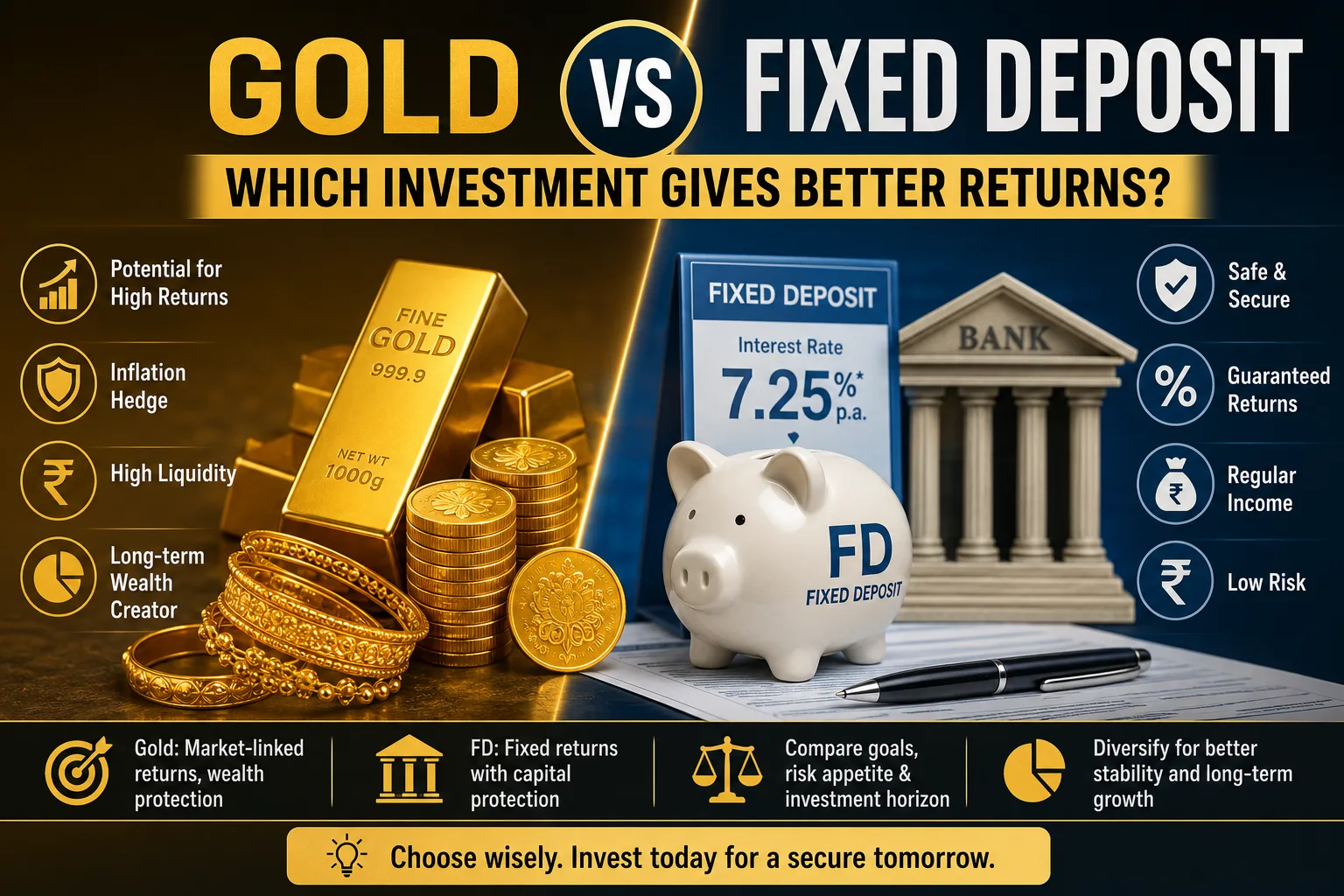
Gold
- Market-linked investment
- Prices fluctuate
- Returns are not guaranteed
Fixed Deposit
- Fixed interest investment
- Stable returns
- Lower market risk
Gold focuses more on wealth growth and inflation protection, while FDs focus on safety and predictable returns.
Gold Returns Over Time
Historically, gold has performed strongly over long periods.
Gold prices often rise during:
- Inflation
- Economic uncertainty
- Global crises
- Currency weakness
In India, gold prices have increased significantly over the last two decades due to:
- Rising demand
- Global market trends
- Rupee depreciation
However, gold prices can also fluctuate in the short term.
Fixed Deposit Returns Over Time
FD returns depend on:
- Interest rates
- RBI policies
- Bank offers
FDs provide:
- Stable returns
- Guaranteed maturity amount
But FD returns are usually lower compared to high-growth investments during strong economic periods.
In recent years, FD interest rates in India have generally ranged between:
- 5% to 8%
depending on the bank and tenure.
Gold vs FD During Inflation
Gold Performs Better During Inflation
Gold is often considered an inflation hedge.
When inflation rises:
- Currency purchasing power decreases
- Gold prices often increase
This helps protect wealth over time.
FD Returns May Reduce After Inflation
Although FDs provide fixed returns, inflation can reduce real profit.
Example:
- FD return = 6%
- Inflation = 7%
Real purchasing power may actually decrease.
This is one reason many investors include gold in their portfolio.
Risk Comparison
Gold Investment Risks
Gold prices may fluctuate because of:
- Global economic conditions
- Market volatility
- International tensions
- Dollar movement
Short-term price drops are possible.
Fixed Deposit Risks
FDs are considered low-risk investments.
Main advantages:
- Guaranteed returns
- Stable maturity amount
- Lower volatility
However:
- Returns may not beat inflation
- Taxation can reduce actual profit
Liquidity Comparison
Gold Liquidity
Gold is highly liquid because it can be:
- Sold easily
- Exchanged quickly
- Pledged for loans
Gold loans are extremely common in India.
Fixed Deposit Liquidity
FDs can also be withdrawn early, but:
- Penalties may apply
- Interest rates may reduce
Gold generally offers faster emergency liquidity.
Taxation Difference
Gold Taxation
Gold profits may attract:
- Capital gains tax
Depending on the holding period and profit earned.
FD Taxation
FD interest is taxable according to:
- Your income tax slab
This can reduce net returns significantly for high-income investors.
Gold Jewellery vs Investment Gold
It is important to understand:
- Jewellery is not always ideal for pure investment
Jewellery includes:
- Making charges
- Wastage
- GST
For better investment efficiency, many people prefer:
- Gold coins
- Gold ETFs
- Sovereign Gold Bonds
- Digital gold
Safety Comparison
Gold Storage Concerns
Physical gold requires:
- Safe storage
- Lockers
- Security protection
Digital gold and ETFs reduce these concerns.
FD Safety
FDs in reputed banks are generally considered very safe.
They provide:
- Stability
- Predictable returns
- Banking security
This makes FDs popular among conservative investors.
Which Investment Performs Better During Economic Crisis?
During global uncertainty:
- Gold prices often rise
- Investors move toward safe assets
Gold usually performs strongly during:
- Inflation
- Currency weakness
- Stock market crashes
FDs remain stable but may not generate high growth during such periods.
Which Is Better for Long-Term Wealth Creation?
Historically:
- Gold has delivered strong long-term appreciation
- Especially during inflationary periods
However:
- Returns are market-dependent
- Short-term volatility exists
FDs provide:
- Stability
- Guaranteed returns
- Lower growth potential
Which Investment Is Better for Senior Citizens?
Many senior citizens prefer FDs because of:
- Stable monthly income
- Guaranteed returns
- Lower risk
At the same time, some allocation to gold helps:
- Protect against inflation
- Diversify savings
Balanced investment planning is often recommended.
Can You Invest in Both?
Yes. Many financial experts recommend combining both.
Example:
- Fixed Deposits for stability
- Gold for inflation protection and long-term growth
This creates:
- Better diversification
- Reduced risk
- Balanced financial planning
Gold vs FD: Quick Comparison
Who Should Choose Gold?
Gold may suit:
- Long-term investors
- Inflation-conscious investors
- Wealth diversification seekers
- People comfortable with market fluctuations
Who Should Choose Fixed Deposits?
FDs may suit:
- Conservative investors
- Senior citizens
- Short-term savers
- People needing predictable returns
Important Tips Before Investing
Before investing:
- Define your financial goal
- Understand risk tolerance
- Compare returns after tax
- Diversify investments
- Avoid investing everything in one asset
Balanced investing usually works better than depending entirely on a single investment type.
Conclusion
Both gold and fixed deposits offer unique advantages. Gold provides strong long-term wealth protection, inflation resistance, and higher growth potential during uncertain economic conditions. Fixed Deposits, on the other hand, offer safety, stable returns, and predictable income with lower risk.
If your goal is capital safety and regular returns, Fixed Deposits may be more suitable. If your goal is long-term wealth creation and inflation protection, gold can be a better option.
For many Indian investors, a balanced combination of gold and fixed deposits often provides the best financial stability and diversification over time.
Check Live Gold Prices
Get today's gold rate for your city — updated throughout the day.
See Gold Price Calculator